
Lorem Ipsum è un testo segnaposto utilizzato nel settore della tipografia e della stampa.
Industrial Emission Control: Operating Principles and Efficiency of Multi-Stage Scrubbers
Artur Cokaj — Researcher and Designer of Air Treatment Technologies
Inventor and holder of industrial invention patent no. 102022000000572
Technical Manager pursuant to Italian Ministerial Decree 37/2008, Sections A, C, D, E
The treatment of industrial emissions starts with the analysis of the substances actually present in the air stream. An emission may contain solid particulate matter, liquid aerosols, condensable substances and gaseous contaminants. These components have different properties and require specific separation mechanisms.
Wet scrubbers use contact between the air stream and a liquid phase. When treating particulate matter and aerosols, the aim is to capture the particles and transfer them into the scrubbing liquid. When treating gaseous contaminants, mass transfer between the gas and liquid phases becomes the main mechanism and depends on the solubility of the substance, temperature, equilibrium conditions and, where required, chemical reactions within the scrubbing solution.
This distinction is important: an efficiency measured for particulate matter cannot automatically be applied to VOCs, acid gases or other substances present in the gas phase.
Why Use Multiple Treatment Stages
When emissions contain different types of contaminants, it can be useful to divide the treatment into several consecutive zones. Each stage is designed to perform a defined function on the air stream.
A configuration may include, for example, a first section for conditioning and particulate separation, followed by a gas-liquid absorption stage and, where necessary, a final section to reduce droplet entrainment.
In other applications, the stages may be entirely physical and use water without chemical reagents.
Multi-stage therefore does not necessarily mean multi-reagent. The treatment sequence must be selected according to the contaminant and the actual operating conditions of the plant.
When several independent stages act sequentially on the same contaminant, the theoretical overall efficiency can be expressed as:
ηtot = 1 − (1 − η₁)(1 − η₂)…(1 − ηₙ)
Actual performance, however, depends on operating conditions. Increasing the number of stages does not automatically produce a proportional increase in efficiency.
Gas-Liquid Contact and L/G Ratio
In wet treatment systems, liquid distribution and contact with the air stream directly affect performance.
One of the parameters used in design is the liquid-to-gas ratio (L/G), which is the ratio between the flow rate of the scrubbing liquid and the flow rate of the gas being treated.
An insufficient liquid flow rate can reduce capture or absorption capacity. An excessive increase, however, leads to higher pumping energy consumption and changes the fluid-dynamic conditions inside the equipment.
Gas velocity must also be compatible with the geometry of the system. High velocities may increase droplet entrainment and pressure drop, while unsuitable values can reduce effective contact between gas and liquid.
Design therefore requires a balance between flow rate, velocity, water distribution, contact time and pressure drop.
When Chemical Reagents Are Required
Water is the simplest scrubbing liquid, but not all gaseous contaminants are sufficiently soluble in water.
In some applications, solutions containing reagents are used to increase absorption capacity or to produce a chemical reaction with the contaminant transferred into the liquid phase.
The pH may become an operating parameter and, where specific oxidation-reduction reactions are involved, the redox potential may also be monitored.
This cannot be defined generically. The composition of the emission, contaminant concentration, flow rate, temperature and chemical properties of the substance must be known.
Particulate Matter and Gaseous Contaminants Are Not the Same
In common language, the term “smoke” is often used to describe the entire stream leaving a combustion or production process.
From a technical point of view, that stream may contain gases, solid particles, aerosols and condensable substances at the same time.
A scrubber designed for particulate matter must create the conditions required to capture the particles and separate them from the air stream.
A system designed for the absorption of gaseous contaminants must instead allow molecules to transfer from the gas phase to the liquid phase.
The two functions can be integrated within the same plant, but they must be designed and assessed separately.
This distinction must also be maintained when discussing efficiency: every removal percentage must identify the substance measured and the conditions under which the test was carried out.
The Multi-Stage Principle in ETC Water Scrubbers
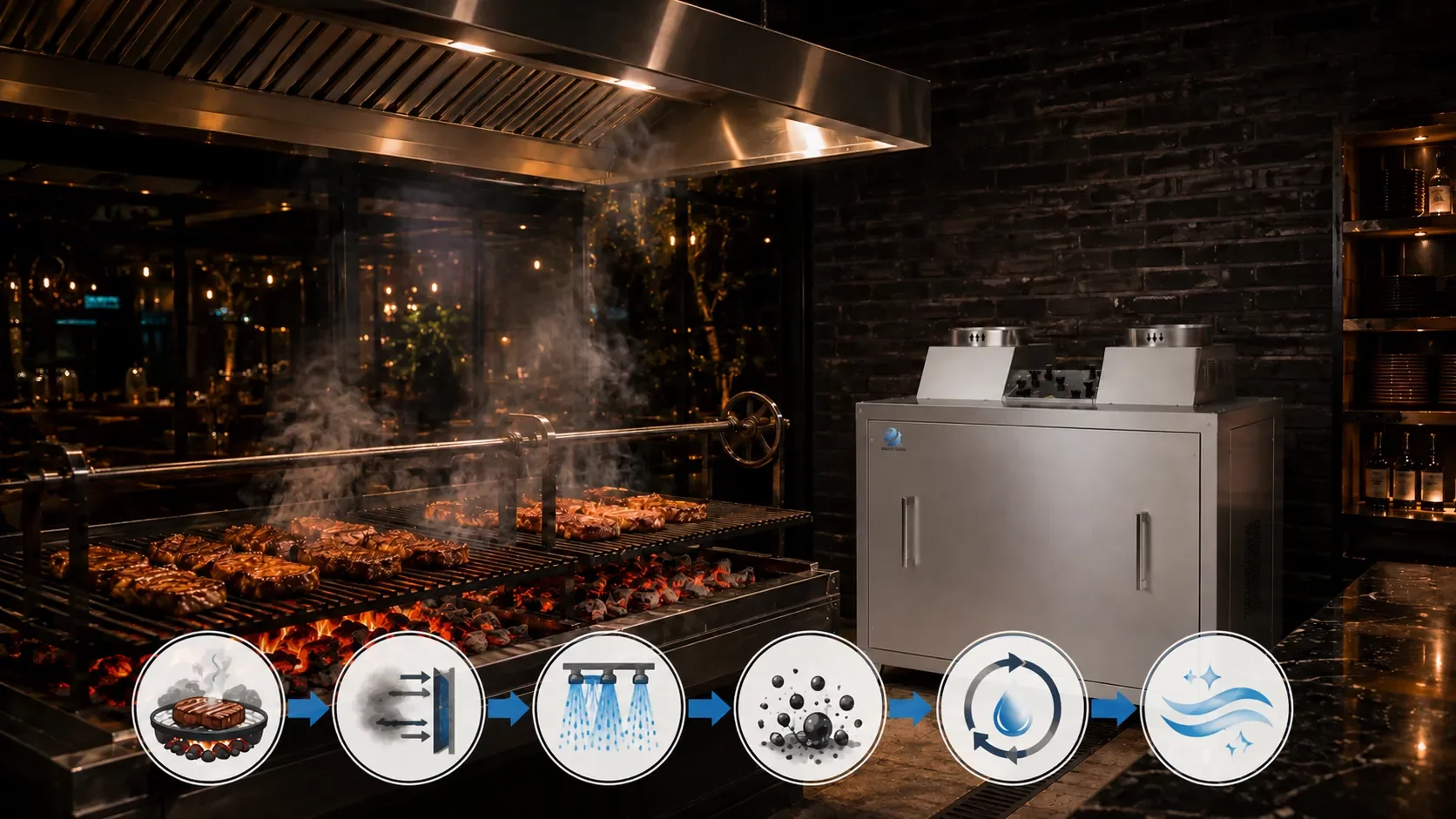
In ETC water scrubbers designed for particulate treatment, the process uses several physical mechanisms on the same air stream.
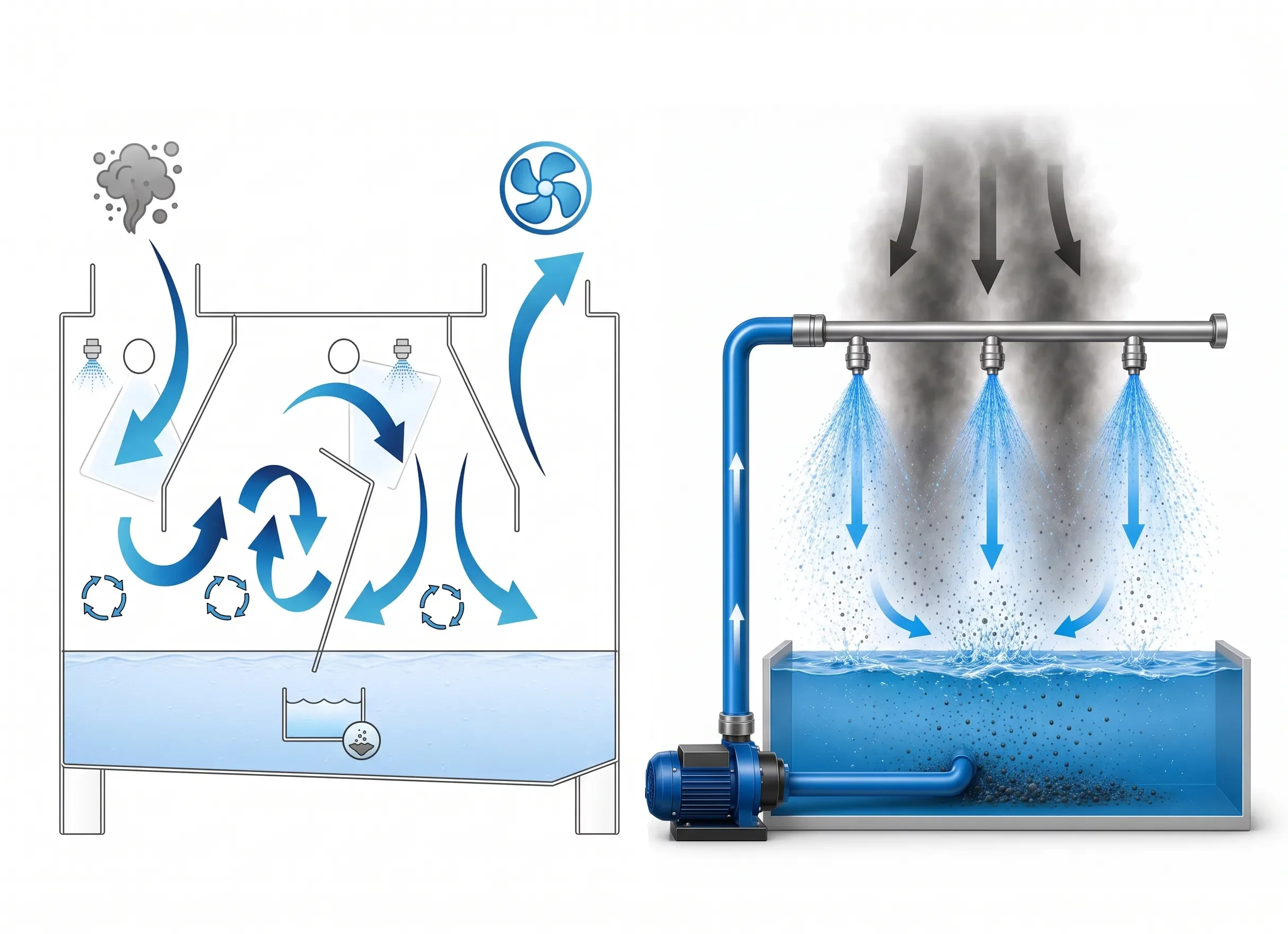
Water is distributed inside the treatment chamber and interacts with the particles carried by the flow. The proprietary geometry of the internal path also forces the air stream through changes in direction, using particle inertia and interaction with water droplets and wetted surfaces.
The captured material is then separated from the flow and directed towards the lower part of the unit, where settling can take place.
The process therefore combines hydrodynamic interaction, inertial separation and gravitational settling, without replaceable mechanical filter elements inside the machine.
In this application, the term multi-stage refers to the sequence of different physical separation mechanisms, not to chemical treatment of gaseous contaminants.
How to Interpret an Efficiency Value Correctly
A removal percentage alone provides incomplete information.
To assess it correctly, at least the following must be known:
the contaminant measured;
the upstream and downstream concentrations;
the test method;
the configuration tested;
the operating conditions;
the laboratory that performed the test.
A value measured for total particulate matter therefore documents the behaviour of the system for that parameter under the tested conditions. It does not automatically demonstrate the same efficiency for chemically different substances.
Correct interpretation of the data makes it possible to distinguish a measured performance from a simple commercial claim.
Design and Operating Control Criteria
Before selecting an emission control system, the air stream must be characterised. The main design data include:
air flow rate;
temperature and humidity;
type and concentration of contaminants;
presence of particulate matter and aerosols;
particle size distribution, where available;
solubility of gaseous components;
variations in contaminant load during the process;
available pressure drop;
applicable emission limits;
material compatibility with the substances being treated;
availability and management of water and any required reagents.
During operation, depending on the technology used, parameters such as gas flow rate, liquid flow rate, temperature, water level, pressure drop, pH and other process-specific values may be monitored.
Abnormal variations from the design conditions may indicate deposits, changes in flow rate, incorrect liquid distribution or other conditions that require inspection.
Operational monitoring does not replace emission measurements required by permits or applicable regulations.
Design Starts with the Actual Emission
There is no single multi-stage configuration suitable for every plant.
In some cases, physical water treatment is sufficient to separate particulate matter. In others, an absorption process is required. When the stream contains contaminants with very different characteristics, several sections may need to be integrated, each with a specific function.
Each additional stage also introduces pressure drop, energy consumption, maintenance requirements and operating costs. For this reason, every stage must have a clearly defined technical purpose.
The efficiency of a multi-stage system depends on the relationship between the actual emission, the treatment principle, fluid dynamics and operating conditions.
Correct design therefore follows a clear sequence: first the air stream is characterised, then the contaminant to be treated is identified, and finally the most appropriate separation process is selected.
Technical Sources and References
U.S. Environmental Protection Agency — Monitoring by Control Technique: Wet Scrubber for Gaseous Control. Principles of gas-liquid absorption, scrubber configurations and operating control parameters.
U.S. Environmental Protection Agency — Air Pollution Control Cost Manual. Technical documentation on wet scrubbing systems and industrial absorber design criteria.
European Commission — Joint Research Centre, Best Available Techniques Reference Document for Common Waste Gas Management and Treatment Systems in the Chemical Sector. Techniques for industrial emission management and treatment.
ETC Group S.r.l. — Technical documentation on water scrubbers and the fluid-dynamic principles used for particulate separation.
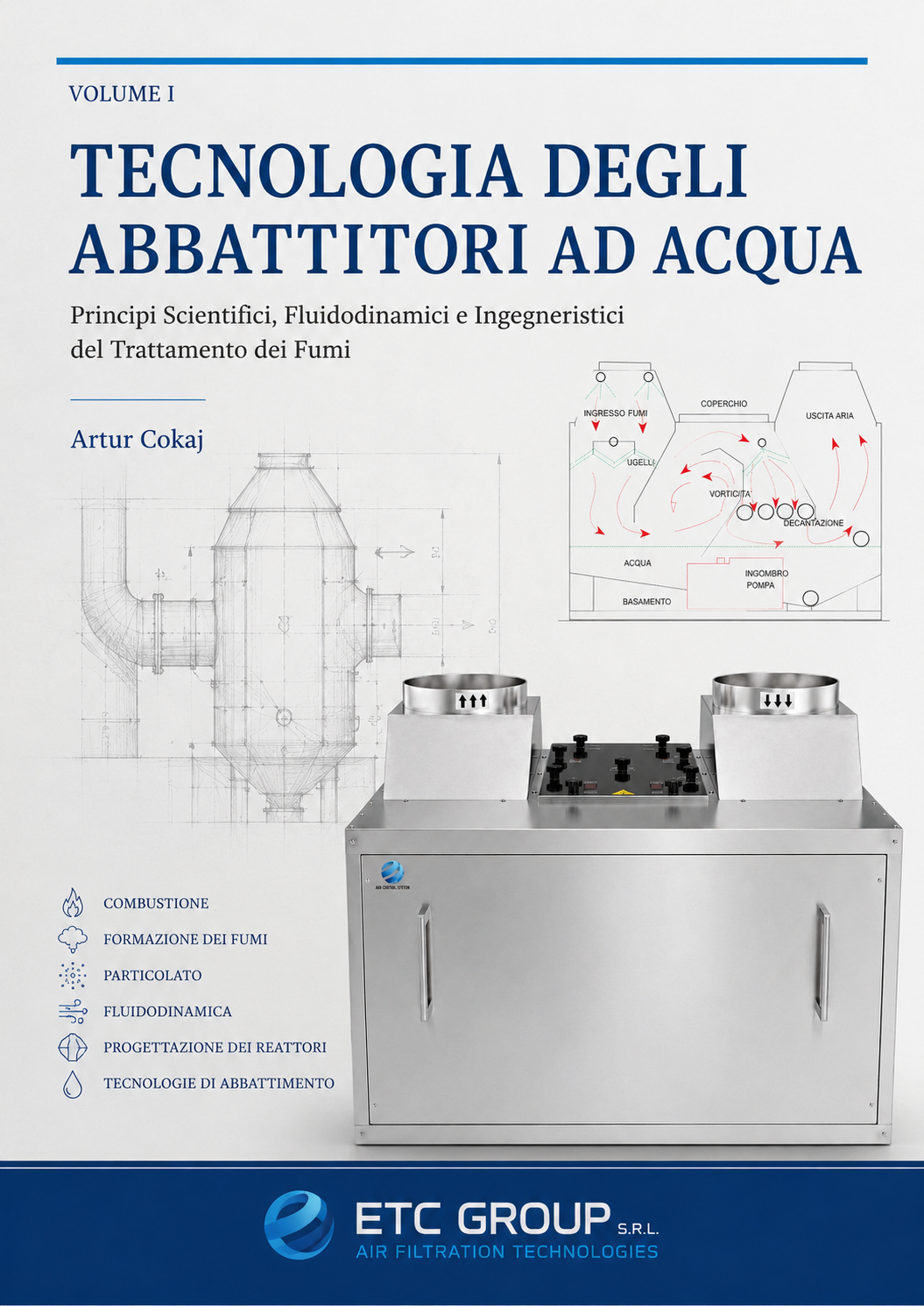
Architecture and washing dynamics of the multistage reactor
In applications for complex industrial emission treatment, the wet scrubber integrates fluid-dynamic contact and chemical reaction sequences into a single compact reactor. The incoming gas stream progressively traverses the various washing sections, where the combined action of atomizing nozzles and high-specific-surface-area media maximizes the mass transfer of pollutants. The differentiated reagent feed for each individual stage allows for the selective neutralization of acidic, alkaline, or odorous compounds within the same machine body. The integrated recirculation loop, continuously monitored via pH and Redox potential parameters, optimizes water and chemical consumption while ensuring high abatement efficiencies with low pressure drops.