

Lorem Ipsum is a placeholder text used in the typesetting and printing industry.
Treatment of cooking air without a flue stack: physics, gas regulations, and design mistakes in professional systems
Eliminating the traditional flue stack, with discharge above the roof ridge, is not merely a cost choice or a site variant. In technical plant engineering, treating the air of a professional kitchen without a dedicated vertical duct means turning a removal problem into a physical and chemical separation problem.
In traditional systems, fluid dynamics exploits the large atmospheric volume for the progressive dilution of contaminants. When, instead, the discharge is through a wall or at a level below the building ridge, the atmosphere offers no dilution margin: the quality of the treated air must be ensured and verified before discharge.
The three critical factors of systems without a flue stack
Field experience and the analysis of administrative disputes show that almost all license blocks by the ASL, complaints from neighbors, and early plant failures stem from three recurring factors:
Failure to understand the physics of aerosols produced by cooking.
The mistaken belief that inertial impact (labyrinth) filters or activated carbon alone can independently clean high thermal loads.
Violation of non-derogable legal constraints related to gas combustion.
Contaminant physics and the regulatory framework
The effluent extracted by a professional hood is not a homogeneous fluid. According to UNI EN 16798-3:2025 (which replaced the previous UNI EN 13779), air extracted from professional kitchens ordinarily falls into contamination categories ETA 3 and ETA 4, i.e., air with high or very high contamination.
The aerosol consists of three analytically distinct populations:
Coarse particulate (diameter > 10 µm): mechanically projected from cooking surfaces. It deposits largely in hood filters or in the first duct section.
Fine and ultrafine aerosol (diameter between 36 and 173 nm): made up of greasy fumes, condensation of organic vapors, and suspended micro-droplets. It is the numerically dominant fraction that reaches the purification unit.
Gaseous fraction (VOCs – Volatile Organic Compounds): aldehydes, ketones, short-chain fatty acids, and aromatic hydrocarbons, responsible for the odor load.
Limits of mechanical filters and activated carbon alone
Labyrinth filters installed at the hood operate by inertial impaction according to UNI EN 16282-2. However, their capture efficiency drops drastically below the micrometer. Using them as the only stage means letting more than 90% of fine particulate penetrate into the duct.
If downstream only an activated-carbon bed is installed, the unretained submicron aerosol deposits directly on the carbon pores. Activated carbon is designed (ISO 10121) for molecular adsorption in the gas phase, not to retain dust or oily condensates. In the presence of hot, greasy fumes, the micro-porosity clogs within a few weeks, compromising the odor function and increasing hydraulic resistance until ventilation is blocked.
Operating principle of the ARTURO System
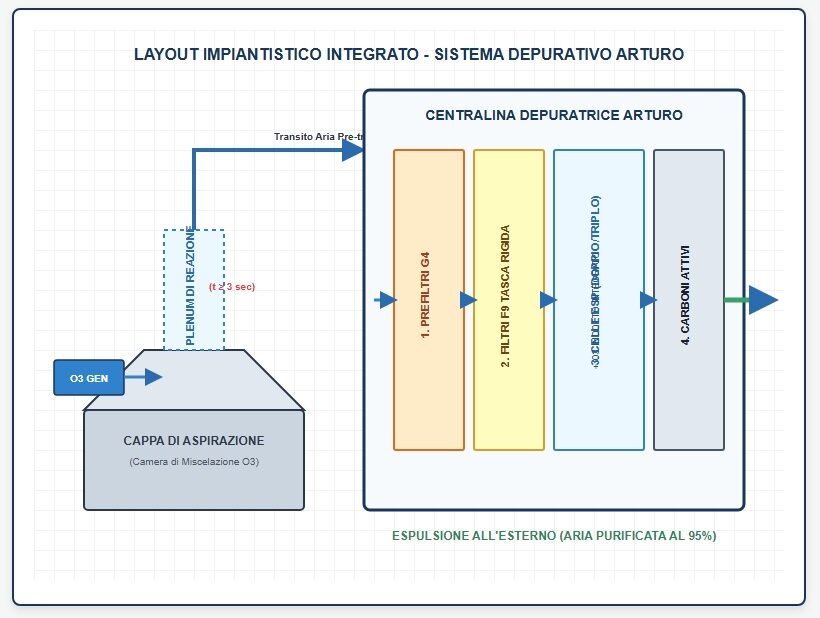
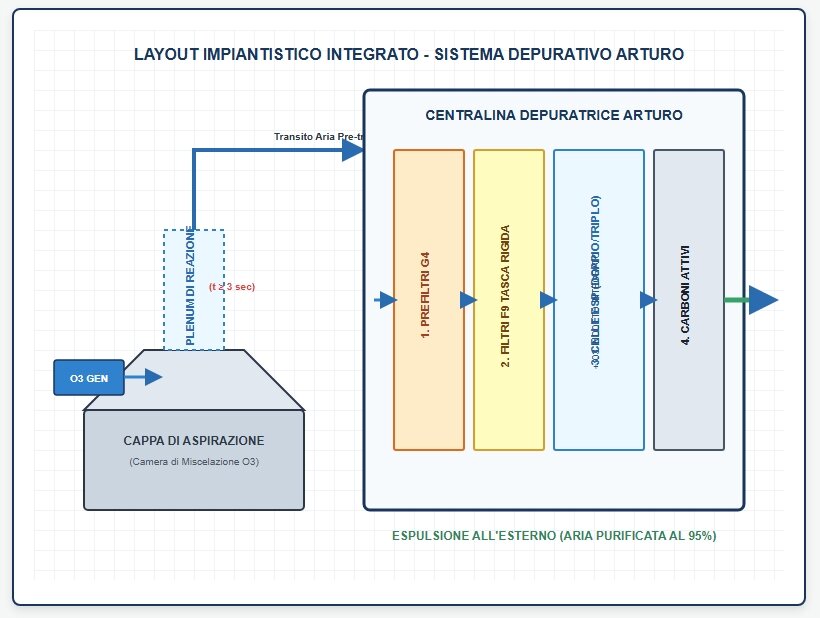
In the ARTURO System, chemical and physical abatement occurs through integration between the extraction hood, transit ducts, and a modular purification unit.
Ozone generators emit the gas directly inside the hood. The space between the labyrinth filters and the inner wall of the hood acts as a first mixing chamber. The extracted air then passes into a plenum designed to ensure a minimum residence time of 3 seconds, allowing ozone to complete oxidation of the odor load in the gas phase.
The air thus pre-treated enters the purification unit, where it passes through a multistage sequence:
G4 prefilters (ISO Coarse 55% according to UNI EN ISO 16890): to block coarse particulate.
F9 rigid pocket filters (ISO ePM1 85%): very high filter surface area to intercept fine particulate.
ESP electrostatic cells (double- or triple-stage): compliant with UNI EN 60204-1 and CEI EN 60335-2-65. Each stage provides a base yield of 90% on fumes, odors, and micro-particulate. In multiple configurations, efficiency multiplies. During ionization, the same stages generate ozone, integrating with the system.
Activated-carbon cartridges (with a dosage of 0.018 kg per m³/h): positioned as a finishing stage for residual molecular adsorption and destruction of excess ozone by chemisorption.
The system’s overall odor-treatment efficiency reaches up to 95%.
The regulatory constraint for gas appliances
One of the most serious conceptual errors at the design stage concerns the regulatory classification of combustion products.
Natural gas / LPG: D.M. 37/2008 and UNI 11528
For gas-fired cooking appliances (cooktops, fryers, rotary ovens), the ventilation system falls within the scope of D.M. 37/2008 and is governed by UNI 11528 for thermal inputs above 35 kW.
Combustion products require specific constraints:
Evacuation outdoors is mandatory. No internal air-recirculation system is permissible for gas equipment.
The derogation for wall discharge (D.Lgs. 152/2006 and Hygiene Regulations) is granted only in the presence of documented technical or architectural impossibility.
Case law and the Sworn Technical Report
Established case-law orientation (TAR Lazio and the Council of State) has ruled that Municipalities cannot preemptively ban alternative filtering systems, provided that performance equivalence is demonstrated.
Demonstration is provided through a Sworn Technical Report signed by a licensed professional, which must document compliance with emission values with ACCREDIA test reports (UNI CEI EN ISO/IEC 17025). Among the parameters:
Total Dust (UNI EN 13284-1): ≤ 3.2 mg/Nm³
Total Organic Carbon – TOC (UNI EN 12619): ≤ 17 mg/Nm³
Residual ozone at discharge (OSHA 214 / EN 60335-2-65): < 0.05 mg/Nm³
Fluid-dynamic sizing criteria according to UNI EN 16282
In traditional systems, performance coincides with volumetric flow rate. In systems without a flue stack, the relationship reverses: flow rate is a constraint, while performance depends on residence time in the treatment stages.
Capture velocity at the hood: calculated between 0.25 and 0.35 m/s at free edges. Excessive flow rates reduce filter efficiency and chemical reaction efficiency.
Residence time and ESP: the face velocity through the cells must be kept low to ensure migration of charged particles.
Static pressure and pressure drops: the centrifugal fan must be selected considering the sum of losses with loaded filters:
G4 prefilters: about 250 Pa
F9 filters: about 350 Pa
ESP cells: limited and almost constant
Activated-carbon cartridges: about 300–400 Pa
Essential technical data for design
Providing only the thermal power (kW) of the appliances is a common mistake. To draft an executive design, the following are required:
Geometric dimensions of the hoods (UNI EN 16282-2): length, width, type (wall or island) for analytical flow-rate calculation.
Physical spaces and structural capacities: footprint of the unit and load-bearing capacity (weights starting from 250 kg per module).
Outdoor discharge point: verification of distances from windows and air intakes, according to the Local Hygiene Regulation or UNI EN 16798-3.
Conclusions
Treating kitchen emissions without a roof flue stack is a sound technical choice, protected by the current case-law and regulatory framework. The success of the intervention lies in integrating complementary technologies: ozone injection in the hood, mixing in a plenum for at least 3 seconds, G4 and F9 prefiltration, ESP electrostatic precipitation, and finishing with activated carbon.
Only this engineering approach ensures compliance with D.Lgs. 152/2006, environmental protection, and full legality of the system.
Artur Cokaj
Researcher and designer of air-treatment technologies
Author of the book "Technology of water scrubbers – Scientific, fluid-dynamic and engineering principles of fume treatment"
Inventor, holder of industrial invention patent no. 102022000000572
Appointed Technical Management Officer D.M. 37/2008 Lett. A, C, D, E
ETC Group S.r.l. – Air Filtration Technologies
Why traditional systems fail against cooking aerosols
Aerosol generated by professional cooking is not uniform. Coarse particles (>10 µm) are stopped by baffle filters, but they represent only the numerically least significant part. The real challenge is the submicron fraction (36–173 nm), which behaves like a gas and passes through mechanical filters by over 90%. Added to this are odorous gaseous compounds, which require oxidation or molecular adsorption. Activated carbon, used without protective stages, clogs quickly with oily particulate, losing efficiency within a few weeks. Each fraction needs a specific technology: only sequential integration ensures stable performance and long-term regulatory compliance.