


- Scrubbers for Wood-fired Ovens
- Scrubbers for Electric Ovens
- Scrubbers for Charcoal Grills
- Stainless Steel Exhaust Fans
ETC Group S.r.l. Sole Shareholder
Industrial area Pirano, Tavullia
Str. Delle Campagne, 10
61010 Tavullia PU - ITALY
Tel.
+39 0721 1839937
+39 0541 955062
+39 0541 1646150
WhatsApp-web +39 373 7755779
E-Mail DEPARTMENTS
informazioni@etcgroupsrl.biz
commerciale@etcgroupsrl.biz
tecnico@etcgroupsrl.biz
contabilita@etcgroupsrl.biz
VAT and Tax Code: IT 04083110405
Reg. of companies of Pesaro N. REA - PS – 196574
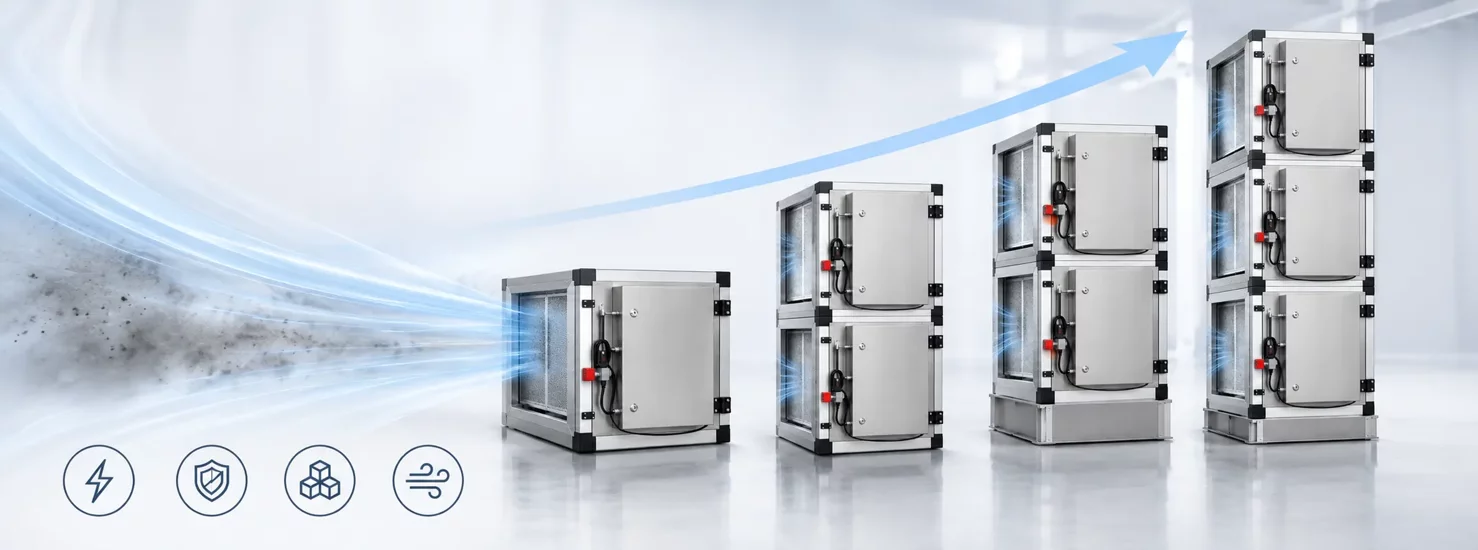
Industrial Electrostatic Filters ESP
ESP systems for the separation of fumes, particulate matter, aerosols, and oil mists in industrial extraction systems.

* This website uses artificial intelligence tools to support text, images, and virtual assistants; all research, projects, solutions, and inventions are the result of human intellectual work. Automated responses are provided for informational purposes only and are non-binding.
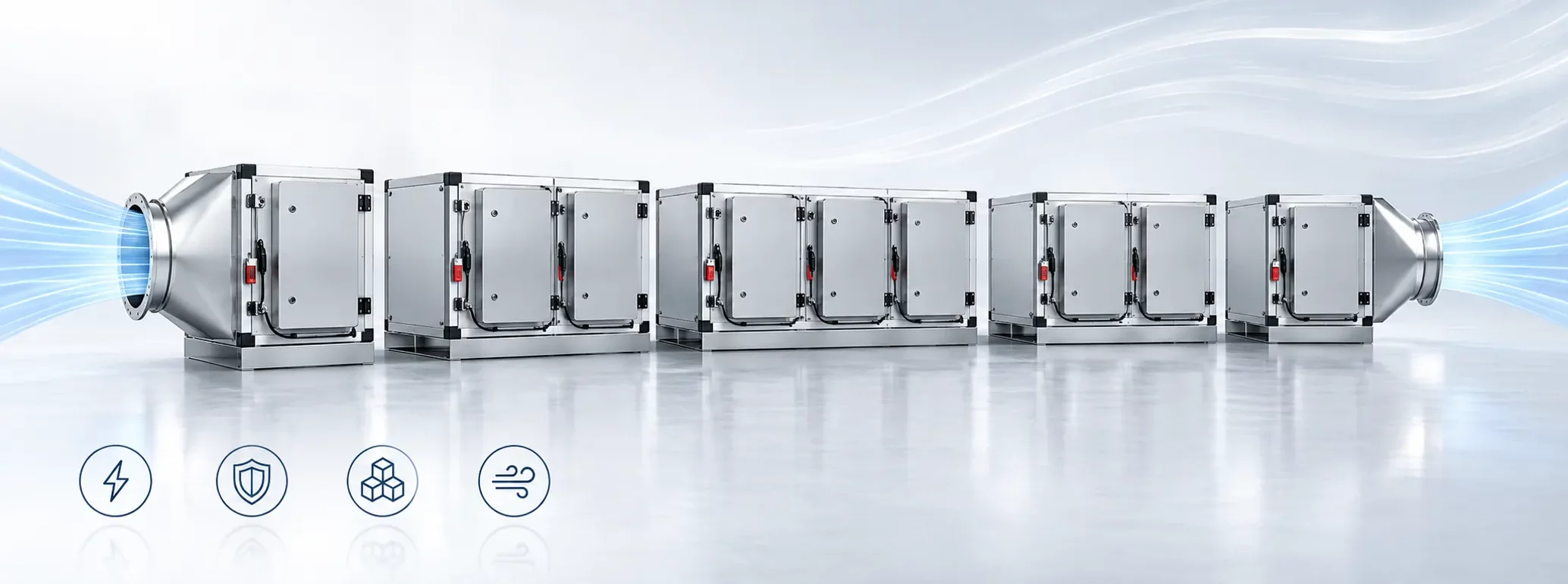
INDUSTRIAL AIR TREATMENT TECHNOLOGY
ESP electrostatic filtration for industrial fumes and particulates
ESP technology separates fumes, particulate matter, aerosols, and oil mists from the air stream through an ionization and electrostatic capture process.
Modular systems configured according to air flow rate, production process, and emission characteristics.
≋ LOW PRESSURE DROP – Optimized air flow for industrial plants
▦ MODULAR SYSTEM – Configurable according to capacity
⚡ ESP TECHNOLOGY
Electrostatic particle separation
🛡 STEEL STRUCTURE
– Durable for industrial applications
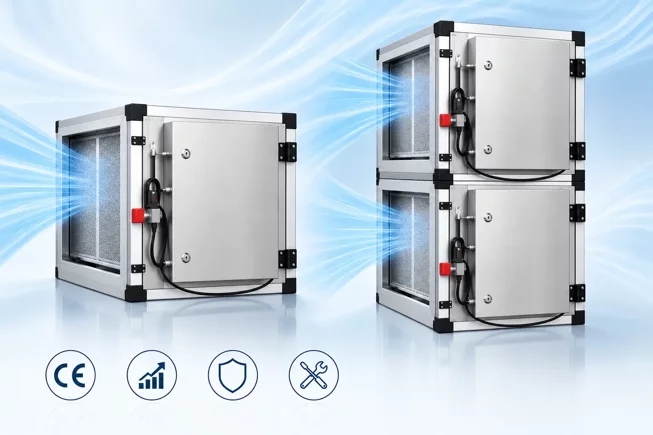
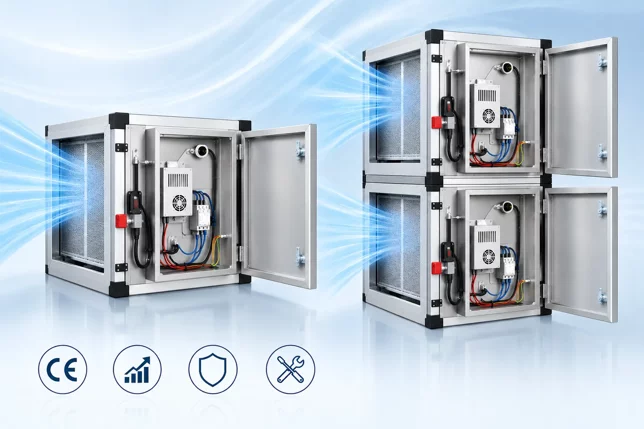
How Electrostatic Filters Work
Electrostatic filters use an ionization and electrostatic attraction process to capture airborne particles such as smoke, grease, and fine dust. This technology provides high filtration efficiency while maintaining low energy consumption.
1. Air Ionization
Contaminated air passes through a section equipped with high-voltage electrodes that generate an electrostatic field. During this process, airborne particles receive an electrical charge.
2. Particle Attraction
Charged particles are attracted to metal collector plates with opposite polarity. Smoke, grease, and dust particles are trapped inside the filter system.
3. Air Purification
The system helps reduce airborne contaminants and suspended particles, improving indoor air quality in professional and industrial environments.
4. Clean Air Release
After the filtration process, purified air is released back into the environment with a significant reduction in smoke, odors, and particulate matter.
Main Advantages of Electrostatic Technology
- High-efficiency filtration for smoke and grease.
- Reduction of emissions and improvement of air quality.
- Washable and reusable system.
- Lower maintenance compared to traditional filtration systems.
- Professional solution for kitchens and industrial applications.
Electrostatic filters represent a modern and efficient air treatment technology designed to ensure high performance, reliability, and long-term durability.
Industrial Electrostatic Filters
Cleaner Air and a Safer Environment
Industrial electrostatic filters are an advanced solution for air purification in professional kitchens, laboratories, and industrial systems. Thanks to ESP (Electrostatic Precipitator) technology, these systems effectively remove smoke, grease, fine dust, and airborne particles, improving air quality and reducing emissions.
Manufactured entirely in AISI 304 stainless steel, ETC Group electrostatic filters ensure high corrosion resistance, long service life, and reliable performance even in intensive working conditions. The system is designed to provide easy maintenance, low energy consumption, and high filtration efficiency.
Advantages of Electrostatic Filters
- High filtration efficiency: removes up to 95% of smoke, grease, and particulate matter.
- Cleaner air: reduces odors and airborne contaminants.
- AISI 304 stainless steel construction: maximum durability and corrosion resistance.
- Low energy consumption: efficient technology with reduced operating costs.
- Easy maintenance: quick access to internal components for fast cleaning operations.
- Professional system: ideal for restaurants, industrial kitchens, and extraction systems.
Available Models
- 592x592x300 mm: ideal solution for high-capacity professional systems.
- 287x592x300 mm: perfect for compact professional kitchens and standard installations.
Professional Air Filtration Technology
ETC Group electrostatic filters are engineered to deliver high-performance smoke removal and air treatment in professional environments. The combination of electrostatic technology, stainless steel construction, and simplified maintenance makes these systems a reliable choice for improving air quality, safety, and operational comfort.
For more information about ETC Group industrial electrostatic filters, contact our technical team.
FREQUENTLY ASKED QUESTIONS ABOUT INDUSTRIAL ESP ELECTROSTATIC FILTERS
What is an industrial ESP electrostatic filter?
An industrial ESP electrostatic filter is an air purification system that uses an electric field to separate fumes, particulate matter, aerosols, and oil mists from the air stream. Particles are electrically charged and attracted to the collection surfaces of the electrostatic cell.
What does ESP mean in industrial filtration systems?
ESP stands for Electrostatic Precipitator. It is the technology used to separate solid or liquid particles suspended in the air through ionization and electrostatic capture.
How does an industrial electrostatic filter work?
Contaminated air enters the electrostatic cell, where particles are electrically charged. They are then attracted and retained on the collection surfaces. The treated air continues towards exhaust or further filtration stages.
Which contaminants can an industrial electrostatic filter treat?
An industrial electrostatic filter can be used for the treatment of particulate matter, fumes, aerosols, and oil mists. The system selection must be based on the production process, emission composition, pollutant concentration, and air flow rate.
Is an ESP filter suitable for industrial oil mists?
Yes. ESP technology can be used to separate aerosols and oil mists generated by various industrial processes. Proper sizing depends on air flow rate, contaminant quantity, and process operating conditions.
Can an electrostatic filter be used for welding fumes?
Electrostatic technology can be evaluated for treating particulate matter produced by welding and other metalworking processes. Before sizing, the type of process, materials used, fume composition, and air flow rate must be analyzed.
What is the difference between an ESP electrostatic filter and a mechanical filter?
A mechanical filter retains particles through a filter medium. An ESP electrostatic filter instead uses an electric field to charge particles and attract them to collection surfaces. In many industrial plants, the two technologies can be used together.
Why do electrostatic filters have low pressure drops?
Particle separation occurs mainly through electrostatic effect and not exclusively through a compact filter medium. This allows systems to be designed with low aerodynamic resistance, an important aspect in industrial extraction systems.
How is an industrial electrostatic filter sized?
Sizing must start from the actual air flow rate, expressed in m³/h. Additionally, the type of process, contaminant produced, temperature, particulate concentration, duct dimensions, fan pressure, and operating hours must be evaluated.
How many ESP electrostatic filters are needed for an industrial plant?
The number of ESP cells depends on the air flow rate and plant operating conditions. The modular configuration allows multiple electrostatic cells to be used to adapt the system to the application's characteristics.
What sizes are ETC Group electrostatic filters available in?
The described range includes electrostatic modules in sizes 592 × 592 × 300 mm and 287 × 592 × 300 mm. The number and arrangement of cells are defined according to flow rate and system characteristics.
Are ETC Group electrostatic filters made of steel?
Yes. The structure of the systems described in this range is made of steel, chosen to ensure robustness and resistance suitable for industrial applications.
Is it possible to install an ESP filter on an existing extraction system?
In many cases, yes. Before installation, the air flow rate, available pressure, duct dimensions, fan position, available technical space, and maintenance accessibility must be verified.
How much space is needed to install and maintain an electrostatic filter?
In addition to the space occupied by the filter unit, sufficient technical space must be provided to open the machine and extract the electrostatic cells. Accessibility should be considered during the system design phase.
How often should an industrial electrostatic filter be cleaned?
There is no uniform cleaning interval for all systems. Frequency depends on the quantity and type of contaminant, operating hours, production process, and the presence of any pre-filtration systems.
Are electrostatic cells washable and reusable?
Electrostatic cells are designed to undergo periodic cleaning and maintenance. They do not function as a disposable filter to be replaced after each cycle. Cleaning operations must be performed according to the instructions for the installed model.
Is it useful to install a pre-filter before the electrostatic filter?
In many applications, yes. A pre-filter can intercept coarser particles before they reach the electrostatic cell, reducing the load on the ESP system. The need and type of pre-filtration depend on the process and contaminant.
Does an industrial electrostatic filter also remove odors?
The ESP electrostatic filter is primarily designed to separate particulate matter and aerosols. Odorous substances present in the gas phase may require additional treatment systems, chosen according to the nature of the emission.
Can an electrostatic filter treat any type of industrial smoke?
No. Compatibility must be evaluated based on emission characteristics. The electrostatic filter should not be automatically chosen for flows containing flammable or explosive gases, highly corrosive substances, or other conditions incompatible with the equipment.
What data is needed to choose an ETC Group industrial electrostatic filter?
For an initial technical assessment, the air flow rate in m³/h, type of process, contaminant produced, flow temperature, duct dimensions, fan characteristics, operating hours, and available space are useful. Photographs, technical drawings, and system diagrams allow for a more precise definition of the most suitable ESP configuration.